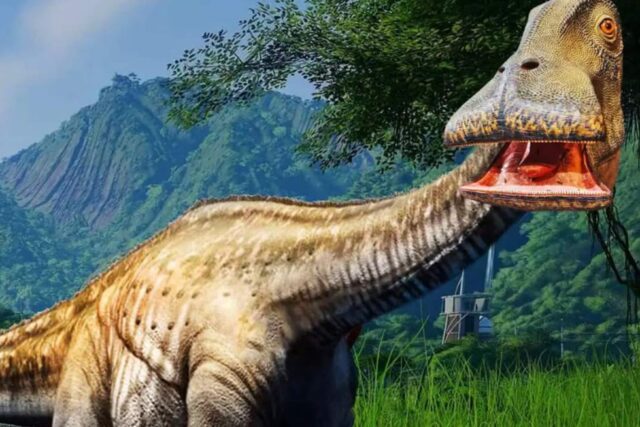
Meet Nigersaurus: The 500-Tooth Dinosaur
Nigersaurus taqueti is the only known dinosaur that possessed more than 500 functional teeth at any given time. Nicknamed the “Mesozoic cow” and sometimes jokingly called a “dinosaur vacuum cleaner,” this unusual sauropod from the middle Cretaceous period continues to fascinate scientists and the public alike. Despite its relatively recent naming in 1999, Nigersaurus has become one of the most talked-about dinosaurs on the internet, largely because of the viral question: “What dinosaur has 500 teeth?”
When and Where Did Nigersaurus Live?
Nigersaurus lived approximately 115 to 105 million years ago during the early Cretaceous period, specifically in the Aptian–Albian ages. Its fossils have been found in the Elrhaz Formation in an area known as Gadoufaoua, in the Republic of Niger, West Africa. At that time, this region was a lush floodplain crossed by rivers, very different from the harsh Sahara Desert we see today.
A Mouth Like a Vacuum Cleaner
The most striking feature of Nigersaurus is its broad, straight-edged muzzle equipped with a dental battery of over 500 teeth arranged in more than 50 columns. Unlike the narrow snouts of most sauropods, Nigersaurus had a wide, square-shaped mouth that resembled a vacuum cleaner head. The teeth were small, slightly curved, and positioned only at the very front of the jaws, perfect for cropping low-growing vegetation close to the ground.
Why So Many Teeth?
Nigersaurus had an extreme tooth-replacement system. Paleontologists estimate it replaced each tooth every 14–30 days—one of the fastest rates ever recorded among dinosaurs. With nine replacement teeth stacked behind each active tooth in every column, the dinosaur constantly renewed its cutting edge. This adaptation allowed it to maintain a perpetually sharp “dental comb” despite heavy wear from grinding tough plants.
The Weirdest Skull in Dinosaur History
The skull of Nigersaurus is one of the lightest and most delicately built among large dinosaurs. Large openings (fenestrae) and thin bony struts reduced weight dramatically. The eyes were positioned on the sides of the head, and the nostrils sat high up, almost on top of the skull. Most astonishingly, the jaw joint was located far forward, giving the mouth an almost perpendicular cutting action unlike any other known dinosaur.
How Big Was Nigersaurus Really?
Nigersaurus was a medium-sized sauropod. Adults reached about 9–10 meters (30 feet) in length and weighed roughly 1.5–4 tons—comparable to a modern elephant. Its neck contained 13 cervical vertebrae but was relatively short for a sauropod. The tail was long and whip-like, and the limbs were sturdy and columnar, supporting a low-slung body.
What Did It Eat?
Nigersaurus was a specialized ground-level herbivore. Its diet likely consisted of soft, low-growing plants such as ferns, horsetails, and early flowering plants that grew near riverbanks. The wide mouth and forward-facing teeth allowed it to sweep its head sideways just above the ground, cropping vegetation without needing to lift its head high like other sauropods such as Diplodocus or Brachiosaurus.
The “Mesozoic Cow” Nickname Explained
Paleontologist Paul Sereno, who led the expeditions that rediscovered Nigersaurus, gave it the nickname “Mesozoic cow” because of its grazing habits. Just as cows today graze on grass close to the ground, Nigersaurus appears to have spent much of its day feeding on low vegetation, moving slowly across floodplains and keeping its head near the substrate.
Discovery in the Sahara Desert
The first Nigersaurus bones were collected by French paleontologist Philippe Taquet in the early 1970s during expeditions in Niger. However, the material was fragmentary, and the dinosaur wasn’t formally named until 1999. Major new specimens, including nearly complete skulls, were unearthed between 1997 and 2005 by teams led by Paul Sereno of the University of Chicago and Jeffrey Wilson.
How Nigersaurus Replaced Its Teeth
Each tooth column in Nigersaurus contained one active tooth at the tip and up to nine replacement teeth waiting beneath. As the working tooth wore down, it was shed and quickly replaced by the next tooth moving up the column. CT scans of fossilized jaws show worn teeth at the front and brand-new unworn teeth just millimeters behind, proving this conveyor-belt system operated continuously throughout the animal’s life.
Comparing Nigersaurus to Other Sauropods
Unlike long-necked giants such as Diplodocus, Brachiosaurus, or Argentinosaurus that browsed high vegetation, Nigersaurus belonged to the rebbachisaurid family—sauropods adapted for low browsing. Its closest relatives include Rebbachisaurus from Morocco and Limaysaurus from Argentina, but none approached the extreme dental specialization seen in Nigersaurus.
Fun Facts You Didn’t Know
- Nigersaurus had more teeth than any other known dinosaur, including hadrosaurs and ceratopsians.
- Its teeth were asymmetrical—slightly longer on the outer edge to create a self-sharpening effect.
- The entire skull weighed less than a modern human skull despite being over half a meter long.
- Baby Nigersaurus already had the same dental battery system as adults, just on a smaller scale.
- It shared its environment with predators like the sail-backed Spinosaurus relative Suchomimus and the giant crocodyliform Sarcosuchus.
Why the 500-Teeth Meme Went Viral
Around 2016–2017, the question “What dinosaur has 500 teeth?” began circulating online as a setup for a controversial joke. When people searched the question, they discovered the real answer—Nigersaurus—and were genuinely amazed by this bizarre, lesser-known dinosaur. The contrast between the joke and the actual fascinating science turned Nigersaurus into an internet sensation and introduced millions to a remarkable piece of paleontology.
Is Nigersaurus the Strangest Dinosaur Ever?
While “strangest” is subjective, Nigersaurus consistently ranks among the most unusual dinosaurs discovered. Its combination of a lightweight, perforated skull, vacuum-cleaner mouth, extreme tooth count, rapid tooth replacement, and ground-hugging feeding style has no direct parallel in the dinosaur world. Even compared to other oddities like Therizinosaurus or Deinocheirus, Nigersaurus stands out for the sheer specialization of its feeding apparatus.
Nigersaurus taqueti proves that dinosaurs evolved astonishing solutions to the challenges of survival. More than 100 million years after it roamed the floodplains of what is now the Sahara, this 500-toothed wonder continues to capture imaginations and remind us how diverse and inventive the age of dinosaurs truly was.


MOST COMMENTED
Blog
The Growth of Uploadblog.com in USA: A Go-To Platform for U.S.-Based Writers
Blog
Article Rewriter UploadArticle.com Review: Easy and Efficient Content Rewriting Solution
Blog
Easy-to-Use Sitemap Generator UploadArticle.com – Perfect for Beginners and Pros
Technology
How to Fix SSIS Error Code 469 in Your Data Integration Packages
Sports
Zeochip com (Zoechip) Review: Access, Quality, and User Risks
Education
Ronenia Meaning: Is It a Country or Just an Online Misconception?
Information
Warning: 03301246300 Linked to Housing Fraud Reports