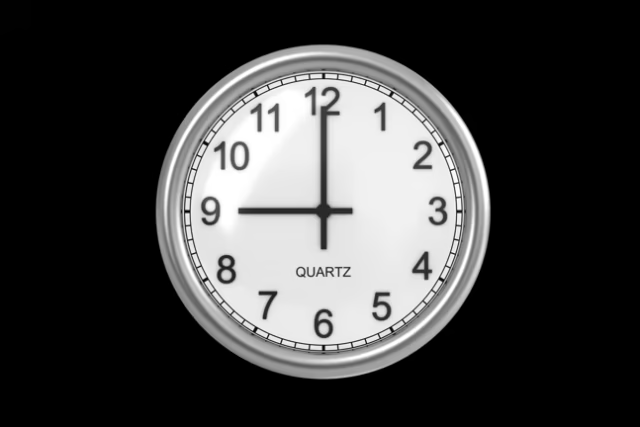
Have you ever needed to figure out what time it was 6 hours ago but didn’t know where to start? Whether you’re tracking a deadline, adjusting to a different time zone, or simply curious, understanding how to calculate time differences is a valuable skill. Time conversions are more than just math—they’re part of how we organize our day, manage schedules across regions, and stay connected in a global world. In this article, we’ll explore exactly how to determine what time it was 6 hours ago, step by step, with simple explanations anyone can follow.
Understanding How Time Works
Before jumping into time calculations, it’s important to understand the basics of how time is measured. A full day has 24 hours, divided into two 12-hour cycles—AM (before noon) and PM (after noon). Clocks track these cycles in local time, but every region on Earth follows a time zone based on its position relative to the Prime Meridian (0° longitude).
When you subtract hours, like figuring out what time it was 6 hours ago, you’re essentially moving backward along that 24-hour timeline. It’s a simple subtraction, but depending on your current time and location, the answer may cross into the previous day or even a different time zone.
How to Calculate What Time It Was 6 Hours Ago
The easiest way to find out what time it was 6 hours ago is by subtracting 6 from your current time. The steps are straightforward:
- Look at your current local time.
- Subtract 6 hours.
- Adjust for AM or PM if needed.
- If the subtraction goes past midnight, move to the previous day.
For example, if it’s currently 3:00 PM, then 6 hours ago it was 9:00 AM.
If it’s 2:00 AM, then 6 hours ago it was 8:00 PM the previous day.
This simple formula works universally, but things can get tricky when dealing with different time zones or daylight saving changes.
Examples to Help You Understand
Let’s go through a few examples to make this clearer:
- Current Time: 10:00 AM → 6 Hours Ago: 4:00 AM
- Current Time: 6:00 PM → 6 Hours Ago: 12:00 PM (Noon)
- Current Time: 1:00 AM → 6 Hours Ago: 7:00 PM (Previous Day)
- Current Time: 11:30 PM → 6 Hours Ago: 5:30 PM
Each example shows that the key is to carefully count back 6 hours and adjust the day if you cross midnight.
Why Knowing What Time It Was 6 Hours Ago Matters
You might wonder why this calculation is useful. The truth is, we use time conversion more often than we realize. Here are a few examples of real-world applications:
- Scheduling: People working across time zones must track meetings or deadlines based on other regions’ times.
- Gaming or Streaming: Many online events run on different time schedules, and knowing the time difference helps players and viewers plan better.
- Travel: Travelers often calculate past or future times to align with flight schedules or family calls.
- Health Tracking: Some apps record data in UTC or another time format, and users may want to convert to their local time to interpret it correctly.
Understanding what time it was 6 hours ago helps you manage your activities precisely and stay in sync with global systems.
How to Calculate Time Differences Manually
To manually calculate time differences, follow this simple method:
- Write down the current time.
- Subtract the number of hours you want (in this case, 6).
- If you go below 12:00 AM, count backward into the previous day.
- Convert between AM and PM properly.
For example, suppose your local time is 5:30 PM.
Subtract 6 hours: 5:30 – 6 hours = 11:30 AM.
If your current time is 4:15 AM, subtracting 6 hours means:
4:15 – 6 hours = 10:15 PM (previous day).
Manually doing this is useful when you don’t have access to a device or want to double-check automated conversions.
Using a Clock or Digital Device
Modern devices make time calculations effortless. Smartphones, computers, and smartwatches allow you to check what time it was with just a few taps. For example:
- On most smartphones, you can open the Clock app, check the World Clock, and manually adjust hours.
- On computers, you can use Time Zone Converter tools to move backward or forward by a certain number of hours.
- Voice assistants like Siri, Google Assistant, or Alexa can answer “What time was it 6 hours ago?” instantly.
These tools simplify time math and eliminate human error, making them perfect for accurate scheduling and planning.
Time Zones and Their Role in Time Conversion
When calculating what time it was 6 hours ago, time zones play a major role—especially when you’re comparing different regions.
The world is divided into 24 time zones, each roughly one hour apart. For instance:
- New York (EST) is 5 hours behind London (GMT).
- Tokyo (JST) is 9 hours ahead of London.
- Sydney (AEST) is 10 hours ahead of GMT.
If you live in New York and want to know what time it was 6 hours ago in Tokyo, you’d have to adjust for the 14-hour time difference between the two.
Example: If it’s 3:00 PM in New York, it’s 5:00 AM the next day in Tokyo.
So, 6 hours ago in New York (9:00 AM) would have been 11:00 PM in Tokyo the previous night.
This example shows that calculating “what time it was 6 hours ago” isn’t always straightforward—it depends on where you are in the world.
Daylight Saving Time Adjustments
Daylight Saving Time (DST) adds another layer of complexity. Some countries shift their clocks forward or backward by one hour each year to make better use of daylight.
If you’re in a region that observes DST, the time difference between locations may temporarily change. For example, in the U.S., clocks move forward by one hour in March and back by one hour in November.
So, when calculating what time it was 6 hours ago during these transitions, always check if your region was in standard time or daylight time. A simple way to verify is to look up the current UTC offset for your location.
Understanding UTC and Global Time
Coordinated Universal Time (UTC) is the world’s standard for keeping time. It doesn’t change for daylight saving and serves as the base reference for all other time zones.
If you know your local time offset from UTC, you can easily calculate time differences anywhere.
For instance, if your region is UTC+5, and it’s currently 8:00 PM, then 6 hours ago it was 2:00 PM UTC+5, which equals 9:00 AM UTC.
This method ensures your time conversions remain accurate across borders, travel plans, and digital systems.
Practical Uses in Everyday Life
Calculating what time it was 6 hours ago may seem like a small detail, but it has many practical benefits:
- Remote Work: Teams across different continents coordinate better when they understand time differences clearly.
- Online Trading: In markets like forex or crypto, where timing is crucial, traders often check past market events by converting times.
- International Communication: Knowing the correct time difference helps avoid calling or messaging at odd hours.
- Learning and Study: Students studying geography or astronomy often deal with time conversion as part of understanding Earth’s rotation.
Being comfortable with time math improves your ability to plan, communicate, and stay organized globally.
Common Mistakes to Avoid
While the math is simple, there are common errors people make:
- Forgetting to switch AM and PM.
- Ignoring the previous day when going past midnight.
- Overlooking time zone changes.
- Not accounting for daylight saving adjustments.
Avoiding these mistakes ensures you always get accurate results, especially when dealing with schedules or deadlines.
Quick Reference Table
| Current Time | 6 Hours Ago |
|---|---|
| 12:00 AM | 6:00 PM (Previous Day) |
| 3:00 AM | 9:00 PM (Previous Day) |
| 6:00 AM | 12:00 AM |
| 9:00 AM | 3:00 AM |
| 12:00 PM | 6:00 AM |
| 3:00 PM | 9:00 AM |
| 6:00 PM | 12:00 PM |
| 9:00 PM | 3:00 PM |
This quick guide helps you find what time it was 6 hours ago without doing the math.
Final Thoughts
So, what time was it 6 hours ago? The answer depends on your current time, location, and whether daylight saving or time zones affect you. By understanding how to calculate and adjust time correctly, you gain a powerful skill that helps in travel, work, and communication.
Time conversion might seem like a small detail, but in today’s connected world, it’s essential. Whether you’re scheduling a global meeting, analyzing data, or simply satisfying your curiosity, these step-by-step tips make finding what time it was 6 hours ago simple, accurate, and stress-free.

MOST COMMENTED
Blog
The Growth of Uploadblog.com in USA: A Go-To Platform for U.S.-Based Writers
Blog
Article Rewriter UploadArticle.com Review: Easy and Efficient Content Rewriting Solution
Blog
Easy-to-Use Sitemap Generator UploadArticle.com – Perfect for Beginners and Pros
Technology
How to Fix SSIS Error Code 469 in Your Data Integration Packages
Sports
Zeochip com (Zoechip) Review: Access, Quality, and User Risks
Education
Ronenia Meaning: Is It a Country or Just an Online Misconception?
Information
Warning: 03301246300 Linked to Housing Fraud Reports